
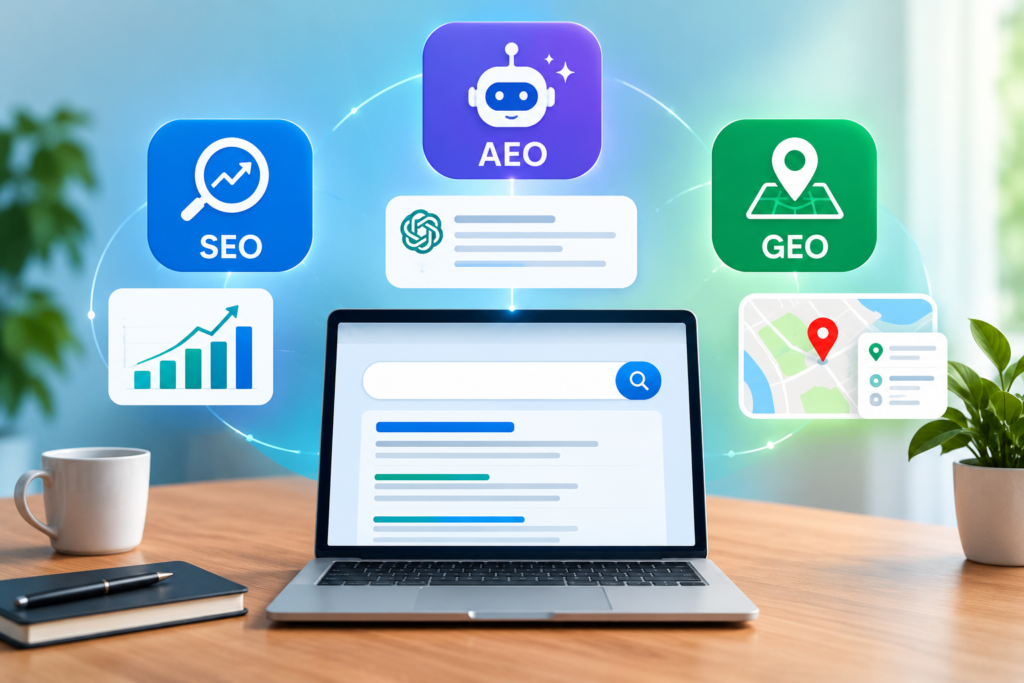
Today, Search is evolving faster than it ever has before, people today can use Google for more than just a list of web pages on search engines, people today is asking much more questions and expecting specific and useful search results from search engines, and, AI generated search. Given this move three acronyms need to come into prominence during 2026; they are: SEO, AEO and GEO. SEO represents Search Engine Optimisation.
Answer Engine Optimisation represents AEO while GEQ will represent Generative Engine Optimisation.
While all of the strategies are different to each other, they ultimately focus on the ways you can make your content become seen during someone doing a search
This doesn’t mean, however, that traditional SEO is irrelevant, right? Not quite, the traditional search optimization has continued and remains, according to Google, in place for the generative AI features in Google Search. In this article let’s analyze what SEO, AEO, and GEO mean for each other in 2026 and how we can use the concepts in partnership.
What Is SEO in 2026?
An improvement of a website so search engines can comprehend,index and rank the web content is called SEO,important jobs like that still are a part of traditional SEO: Keywords analysis, useful and unique contents, technical SEO, internal linking, Meta descriptions & page title, Web usability & velocity, Mobile-friendly designing, Structure for information, Quality backlinks, Local SEO, but rather than filling content with keyword overloads, SEO will revolve around content and search intent by 2026. Google is keeping up its procedures and documents for Search and Google has revised or documented guides for AI search, reputable references, structured data, Search console by 2026 so now is the time to offer what the users will appreciate rather than try to fool Search engines
What Is AEO?
AEO stands for Answer Engine Optimization. When optimizing content the objective is to match search queries that expect a specific and direct answer-for instance the user is likely to search: “What is digital marketing and how can a small business get a bit from it?” rather than simply searching for: “digital marketing”.
Answer Engine Optimization seeks to create content that answers the questions asked directly and plainly.
The way in which to optimize for the answer engine search is: Address relevant big questions directly. Use titles/sub-titles. Provide simpler explanation. Use a ‘ Frequently asked questions’ or FAQ section.
Offer definitive yet helpful answers and information.
Organize this content in a logical way. Where helpful, present information in the form of lists or tables. Ultimately, Answer Engine Optimization isn’t about implementing a range of secret techniques; Google also advocates for effective SEO instead of an over reliance on the perceived AEO or GEO ‘hacks’.
What Is GEO?
GEO generally stands for Generative Engine Optimisation. This entails maximizing the chance that your information is understood, cited or surfacing within an AI-driven search experience. Modern search experiences are generating the ability to integrate information from a range of resources into their AI answers and Google has published best practices to guide website owners as well as enhancing their own generative AI search, and a world of opportunity has opened up for businesses.
The question has changed from: ‘How can I rank number one?’
to ‘How can I transform myself into a credible, helpful answer?’ This requires unique content, precise justifications, factuality, relevant case examples and a subject matter expert.
SEO vs AEO vs GEO
While all three are related to each other, they differ in their ultimate purpose, to some extent:
SEO: Gets your website into conventional search results.
AEO: Ensures that your content thoroughly answers user queries.
GEO: Optimizes your content to make it valuable and discoverable within generative AI search engines.
You should not think of them as 3 unrelated marketing strategies and a sound content strategy will be fundamental for them.
What Has Changed in 2026?
It has brought forth the rising prevalence of AI-powered search.
Google have released an entire guide in 2026 on how to optimize web pages for generative AI functions, which includes guidance relating to local content, shopping content, pictures, videos and information which is not commonplace. However, they go on to acknowledge that traditional SEO practices are still effective within these domains.
Google also now have more integrated versions of AI Mode and AI Overviews, which means that Google are measuring the amount of AI Mode traffic that your website receives within all of its performance metrics included in Google Search Console. You, therefore need to not only consider what your rank in the “traditional” aspect is, but also how your content is performing across newer search experience
How Can Businesses Prepare?
Here’s a better approach than not using SEO: creating stronger content that supports it.
1. Create genuinely useful content:
Focus on human users, not on the algorithm. Understand what readers are searching for and provide useful information.
2. Clarify user intent:
Before starting an article ask yourself: what is the user really looking If your language is more formal, please avoid using a preposition at the end of the sentence.
User searching for ‘Google ads’ cost are not looking to learn ‘how to start a Google ads campaign.’
They are looking for a different thing.
The topic of your content should match user search.
3. Answer the questions directly:
If many of the users are seeking to find the answer for something, add it into your content. Both human users and search engine have clarity about the topic.
4. Develop authority on topic:
Instead of creating an unspecific post after unspecific posts on unrelated topics; take time and make a topic map. Create, on purpose, a series of useful content pieces which are logically connected to the main topic. (Ex. If you’re managing a digital marketing website: SEO, Local SEO, Google ads, social media marketing, content marketing, AI search, keyword research..).
5. Add unique value:
Anyone can create general info. The specific insights are therefore very valuable. Include : Personal examples, case study, concrete examples, data, expertise recommendations, practical guides and original research. Google’s September 2026 guidelines focus on content that’s more than just ‘commoditized’.
6. Reject SEO/AI hacks:
There is a lot of talk about specific Google ranking formulas. In many of cases it is also about specific file formats, or even formulas, that supposedly rank well in AI search. Ignore them and rely on writing a useful content, a technically efficient web site and the regular SEO processes. Google recommends also ignoring specific file formats, a so-called “llms.txt”, unnecessary “chunking of content” in order to cater to the AI.
The Future of Search Is About Being Useful
What they can all tell is that behind their very different faces, are three strategies that are fundamentally pointing to the same concept; delivering value for the user. Businesses in 2026 shouldn’t be worrying about ranking for a keyword. The website should be providing answers, showing expertise and be reliable for searches in a number of different contexts.
Traditional SEO does, and should remain important.
AEO pushes business to consider questions, while GEO refers those creating content toward thinking about being discoverable within generative AI