
Google Ads is changing more quickly than ever before
If you’re still using the same campaign plan you used a year ago, you could be missing out on critical opportunities to generate leads and reduce advertising expenses.“Google will continue to invest heavily in artificial intelligence, automation, audience insights and privacy-focused advertising in 2026. These enhancements aim to increase the efficiency of campaign management, and to help organizations reach the right customers at the right time. to help organizations reach the right customers at the right time and improve the efficiency of campaign management.
The improvements are too many to mention, but if you’re a small business owner, entrepreneur or marketing professional, it’s important to know them so you can stay ahead of the competition.
Let’s look at the biggest Google Ads upgrades for 2026 and how you can take advantage of them to elevate your advertising.
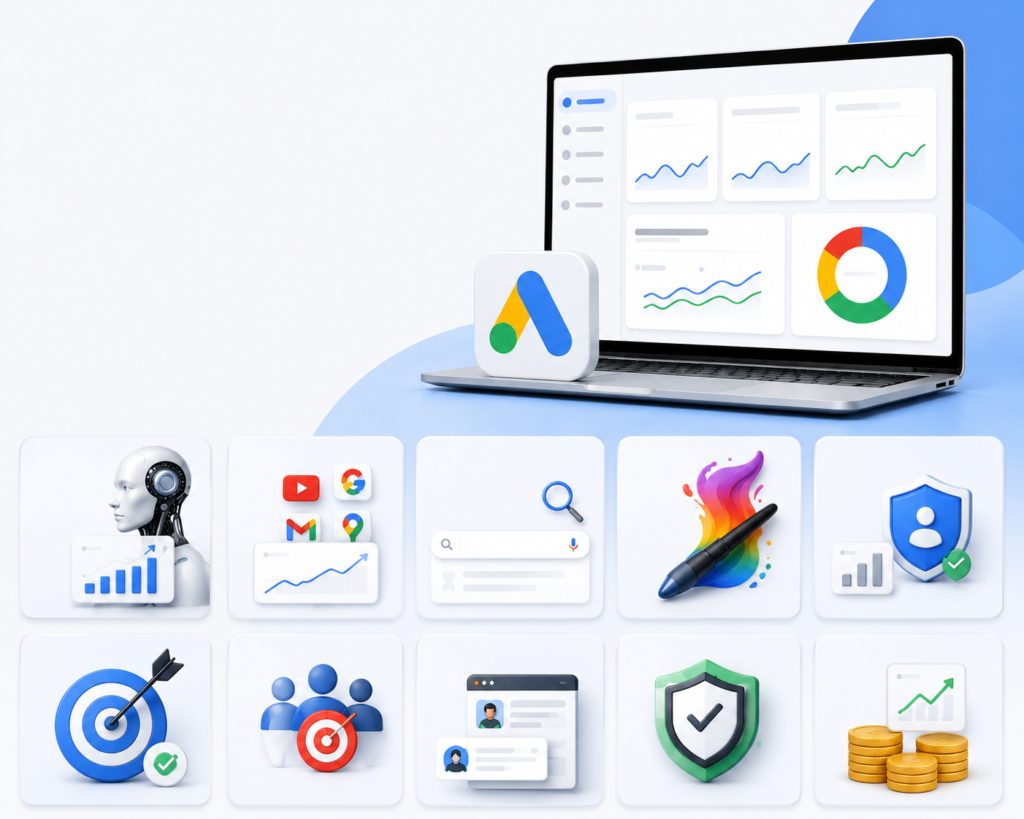
1. AI-Powered Campaign Management Is Smarter Than Ever
Google Ads are increasingly capitalizing on artificial intelligence. Marketers can invest less time in trying to tweak their budget, bids, keywords, and audiences and rely more on Google’s artificial intelligence to make these adjustments based on user behavior. Google’s AI uses tens of thousands of signals, including: Device type User’s location Search intent Time of day Past interactions with the brand Purchase likelihood This technology makes advertising more effective because it helps show the right offer to the right person at the right moment. How can this development impact businesses? Instead of trying to adjust and optimize their campaigns, advertisers should capitalize on this technology and invest more effort in creating attractive ads, landing pages, and conversion tags.
2. Better AI Asset Creation
Ad creation has become much easier to do. Google Ads now offer better support for creating the following AI assets:
Headlines
Descriptions
Images
Variants
Call-to-action suggestions
Instead of creating content from scratch, the users can take the suggestions offered by Google Ads and further personalize them in accordance with their brand’s voice. As an alternative to using generic suggestions, the businesses can opt for the more creative approach and offer customers a better experience.
3. Performance Max Campaigns Continue to Improve
Max campaigns continue to be one of the company’s most lucrative in 2026.
They enable the advertiser to engage with the client across multiple Google platforms, including:
Google Search, YouTube, Gmail,
Discover, Google Maps, and Display Network.
In addition, the recent enhancements enable an advertiser to evaluate the performance of individual elements and audiences to better optimize the campaign. Performance Max campaigns benefit brands that lack the expertise to manage multiple campaigns while expanding their outreach.
4. Search Ads Are Becoming More Intent-Focused
As much as keyword-targeted search is important, user Intent is more important now than it has ever been. Google’s AI understands the intent of the keyword rather than simply matching relevant search terms as was previously the case. For instance, if a user Searching for “best digital marketing expert near me” , they might get relevant ads from companies that have a more extensive array of goods than what the particular ad implies. As a result, advertisements should be constructed around what consumers want to achieve by visiting a certain business rather than concentrating on what a company sells.
5. Improved Audience Insights
Getting to know your audience became easier with the addition of extra valuable audience insights provided by Google Ads. This includes: Customer’s interests Purchasing behavior Device Preferences Returning Visitors High-converting audience segments This information helps the marketers to optimize the advertising campaign and get the money spent on ads in the best way possible. Instead of guessing which audience to target, it is better to rely on proven facts
6. Enhanced Conversion Tracking
it will become possible to track conversion events such as phone calls, form fills, online purchases, appointment setting, and newsletter subscriptions. You can enable Google’s AI to increase the success of your advertising campaigns by focusing on conversions that matter to your business rather than just generating clicks.The ability for the Google AI to improve your advertisements by tracking these important activities, rather than allowing budget to be wasted on ineffective campaigns will be available.
7. Privacy-First Advertising
Google is promoting privacy-focused advertising by gradually eliminating third-party cookies. Businesses are being positioned to benefit from building high-quality first-party audiences by collecting client information through such channels as: Forms on websites Newsletter subscriptions Customer accounts. Loyalty programs This ensures that they can target their audiences accurately while still respecting their privacy. Companies that invest in developing strong customer relationships will see offsprings in the form of improved advertising revenue in the future.
8. Better Reporting and Insights
Campaign reporting is more transparent. Advertisers are now more informed. What assets are best? Which audience segments convert. Search themes that drive traffic Budget Allocation Conversion Trends Businesses can make more informed optimisation decisions by using deeper information rather than just evaluating clicks and impressions. Good reporting makes advertising a sure business growth.
9. Video Advertising Keeps Growing
GoogleAds has expanded video ad inventory on YouTube and other Google properties.As a result, consumers are witnessing a rise in short-form videos, product films, customer endorsements, and instructional videos as a more successful way of engaging consumers than traditional display commercials. Businesses who invest in video content will see an increase in conversions and brand recognition
10. Automation Still Needs Human Strategy
Even in the era of Google Ads automation, people need to remain in control. The fact of using artificial intelligence to maximize bids and placements does not mean that it can replace a human in all tasks. One should understand that algorithms cannot truly grasp the aims of one’s business, customers’ emotions, or the uniqueness of one’s proposal.
The most successful marketers manage to combine the power of algorithms with their own skills, such as Crafting marketing strategies Setting realistic goals Designing landing pages Attractive offers Monitoring ads’ performance regularly Thus, one should see technology as a tool to facilitate the work, not replace human interference.
Best Practices for Running Google Ads in 2026
These best practices should be followed if you intend to initiate or improve your campaigns this year: set the right conversion tracking before investing money in the ads; focus on addressing customers’ pains rather than the keywords; A/B test multiple headlines and creatives on a regular basis; use AI suggestions wisely but take a close look at them before actually publishing the ad; optimize landing pages in order to increase the conversion rates; monitor the campaign performance at least once a week; build first-party data if possible; and combine Google Ads with SEO and content marketing to scale the business in the long run.
Final Thoughts
These best practices should be followed if you intend to initiate or improve your campaigns this year: set the right conversion tracking before investing money in the ads; focus on addressing customers’ pains rather than the keywords; A/B test multiple headlines and creatives on a regular basis; use AI suggestions wisely but take a close look at them before actually publishing the ad; optimize landing pages in order to increase the conversion rates; monitor the campaign performance at least once a week; build first-party data if possible; and combine Google Ads with SEO and content marketing to scale the business in the long run.